



The moment a tenant misses a rent payment, phone them, put the conversation in writing, and open the Pre-Action Protocol for Possession Claims. Doing this within days rather than weeks recovers more of what you’re owed and keeps every legal option open, including court possession and enforcement further down the line.
Waiting is the single most expensive mistake landlords make with tenant arrears collection. Arrears that sit unaddressed for a month tend to compound: the tenant’s confidence to communicate drops, informal arrangements calcify into habits, and you lose the paper trail a court will later expect to see. Citizens Advice and StepChange both exist precisely because early, structured intervention beats confrontation later, and DebtCollect.org exists for the cases that do need a professional collector rather than a solicitor’s letter.
Here’s what to do the moment you notice a payment hasn’t landed:
- Call the tenant the same day, then follow up in writing (email or letter) confirming what was said.
- Freeze any informal concessions, such as agreeing to “catch up next month” with no written terms.
- Start a rent ledger entry logging the missed payment, the date, and every contact attempt.
- Check whether the tenant is claiming Universal Credit or Housing Benefit, since this changes your next steps.
- Note whether anything suggests vulnerability (illness, job loss, bereavement) that needs a documented, sensitive approach.
Key Takeaways
Acting within days of a missed payment, documenting every contact, and following the Pre-Action Protocol together determine whether arrears resolve quickly or end up in court.
| Point | Details |
|---|---|
| Act within 72 hours | Contact the tenant, confirm in writing, and start a rent ledger before arrears grow further. |
| Follow the Pre-Action Protocol | Send a clear letter before action and offer a repayment discussion before issuing court proceedings. |
| Know your Section 8 grounds | Ground 8 is mandatory at two months’ arrears; Grounds 10 and 11 are discretionary. |
| Use benefit routes where relevant | Apply for an Alternative Payment Arrangement or deductions before assuming court is the only option. |
| Bring in professional help when needed | DebtCollect.org matches complex or former tenant arrears cases to vetted collection agencies. |
Table of Contents
- The 24 to 72 hour checklist for tenant arrears collection
- What UK law says about recovering rent arrears
- The step-by-step tenant rent arrears recovery pathway
- Repayment plans and tenants on benefits
- When to bring in a debt collection agency or solicitor
- Records and evidence you need before court
- Mistakes that sink a tenant arrears collection case
- What tenant arrears collection actually costs and how long it takes
- Why early, documented action beats aggressive escalation
- How Debtrecoveryhub helps when self-managed recovery stalls
- Sources
- FAQ
The 24 to 72 hour checklist for tenant arrears collection
The first three days set the tone for everything that follows. Get this window right and you either recover the rent quickly or build a case file that will stand up in court months later.
Within 24 hours:
- Verify the rent schedule against your tenancy agreement so there’s no ambiguity about what’s actually owed.
- Contact the tenant by phone; if there’s no answer, send a written message the same day.
- Ask for a brief income and expenditure picture if the tenant volunteers one, but don’t demand it aggressively.
Within 48 to 72 hours:
- Issue a written notice of arrears stating the amount, the period covered, and a date by which you expect contact.
- Suspend any plan to visit the property unannounced. Give notice for any visit, and never use a visit as leverage.
- Store every communication (texts, emails, call logs) with a timestamp in a single folder, not scattered across devices.
A rent ledger built in a spreadsheet or dedicated accounts receivable software makes this far easier to maintain than a shoebox of paper statements, particularly once a case runs for months rather than weeks.
Pro Tip: Never threaten eviction verbally in the first contact. It rarely speeds up payment, and if the tenant is vulnerable it can tip into harassment territory, which weakens your position if the case ever reaches court.
What UK law says about recovering rent arrears
Arrears simply means rent that’s due under the tenancy agreement but unpaid. The moment you’re chasing more than a token late payment, the Pre-Action Protocol for Possession Claims governs how you must behave before you can issue court proceedings, and courts do check compliance.
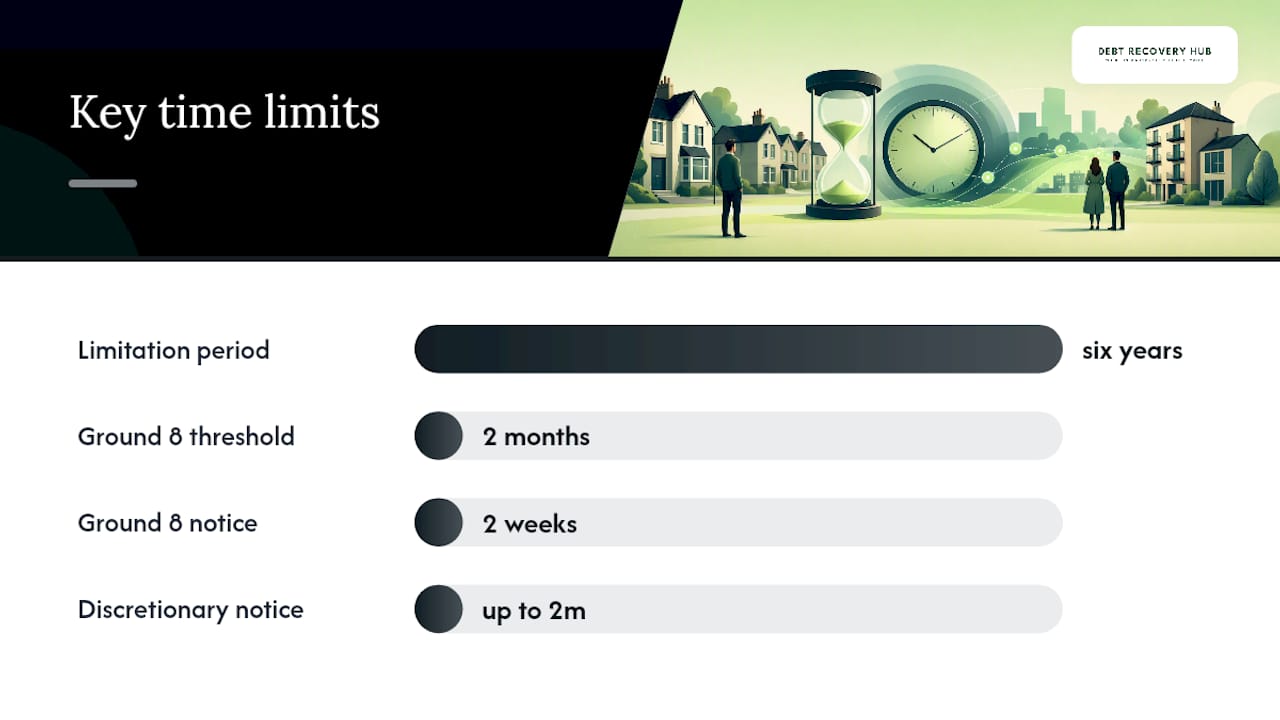
Unpaid rent is a debt, and debts in England and Wales are subject to a six-year limitation period from the date each payment fell due, after which a court claim generally can’t proceed for that instalment.
Section 8 of the Housing Act 1988 gives landlords three relevant grounds for possession based on arrears:
- Ground 8 (mandatory): at least two months’ rent unpaid at both the notice date and the hearing date. If met, the court must grant possession.
- Ground 10 (discretionary): some rent was owed when notice was served, even if less than the Ground 8 threshold.
- Ground 11 (discretionary): the tenant has persistently delayed paying rent, regardless of the current balance.
One risk trips up more landlords than any other: accepting rent after the right to forfeit a lease has arisen can waive that right entirely, according to LexisNexis’s legal guidance. If you’re contemplating forfeiture, take advice before banking any payment, even a partial one, because a single accepted cheque can undo months of legal groundwork.
What the notice must show: the correct ground(s) cited, the exact arrears figure at the date of service, the statutory notice period (usually two weeks for Ground 8, up to two months for discretionary grounds), and proof it was served correctly. Get any of this wrong and the court can strike out the claim, sending you back to square one.
The step-by-step tenant rent arrears recovery pathway
Recovery runs through predictable stages, and skipping one usually costs more time than it saves.
- Prevention and early contact (days 1 to 7): phone calls, written confirmation, and an informal offer to discuss a plan.
- Letter before action (week 1 to 2): a formal written demand stating the arrears, referencing the Pre-Action Protocol, and inviting a repayment proposal.
- Section 8 notice (typically served once arrears reach around two months, depending on the ground used): the formal statutory trigger for possession proceedings.
- Court claim (if unresolved): filed with the County Court once the notice period expires.
- Possession order: granted outright, suspended pending a repayment plan, or refused if the protocol wasn’t followed.
- Warrant and enforcement: if the tenant still doesn’t leave or pay, bailiffs or High Court enforcement officers execute the order.
Letsorted’s step-by-step guide puts the early written notice stage at roughly 7 to 14 days after first contact, with Section 8 typically following after a significant period if arrears persist and nothing’s agreed. Court listing times then add further delay, often several weeks, depending on local court backlogs.
Court proceedings aren’t the only route. Depending on the debt and the tenant’s circumstances, consider:
- Money claim (small claims/CCJ): suitable for smaller, straightforward debts, particularly against a former tenant no longer in the property.
- Charging order: realistic only if the tenant owns property with equity, and typically follows an existing CCJ.
- Attachment of earnings: works when the tenant is employed and traceable, but adds months to the timeline.
Repayment plans and tenants on benefits
A written repayment agreement is worth more than a verbal promise every time. It should state the total arrears figure, the ongoing rent obligation, the agreed instalment amount and frequency, and a clear default clause explaining what happens if a payment is missed. Both parties should sign it, and you should keep a copy alongside your rent ledger.

When a tenant is on Universal Credit or Housing Benefit, Citizens Advice recommends applying for an Alternative Payment Arrangement (APA), which redirects the housing element of Universal Credit straight to you rather than the tenant. Deductions from ongoing benefit payments can also claw back arrears gradually without a single court hearing. Discretionary Housing Payments (DHPs) from the local council are worth flagging to tenants too, since they can plug a genuine shortfall.
Before pushing hard on any of this, run a quick vulnerability check: is there illness, a recent bereavement, a disability, or a language barrier affecting the tenant’s ability to engage? Document what you observe and adjust your approach accordingly. Persistent contact that ignores clear vulnerability signals risks tipping into harassment, and forcing someone out without following the correct process risks an illegal eviction claim, which carries far heavier consequences than a delayed rent payment ever will.
Pro Tip: Signpost tenants to Citizens Advice or StepChange before the situation escalates. A tenant who gets independent debt advice early is far more likely to stick to a repayment plan than one who feels cornered.
When to bring in a debt collection agency or solicitor
Some cases genuinely need professional help. The usual triggers are: the debt has grown beyond a few months’ rent, the tenant has already moved out (former tenant arrears are notoriously harder to chase), the benefits picture is complicated, or you simply don’t have the time to manage weekly follow-ups yourself.
Before instructing anyone, check:
- Whether the agency or solicitor is properly regulated and, where relevant, ICO-registered for data handling.
- Whether they charge commission on recovered sums or a fixed fee, and what happens if nothing is recovered.
- Whether they have specific experience with property and rental debt, not just general consumer collections.
- What their typical recovery timeline and success rate look like for cases similar to yours.
Pro Tip: A generic collections agency picked at random often struggles with the nuances of tenancy law, deposit deductions and benefit-linked debts. DebtCollect.org’s matching process pairs your case with agencies experienced specifically in property-related debt, which cuts down the trial-and-error of picking blind.
Records and evidence you need before court
Courts and collection agencies both work from paperwork, not memory. Build this file from day one rather than scrambling for it once a hearing date lands.
| Document | Why it matters |
|---|---|
| Signed tenancy agreement | Confirms the rent amount, due dates and tenancy terms the claim relies on. |
| Rent ledger | Shows every payment, missed payment and date, forming the core evidence of arrears. |
| Bank statements | Independently verify what was and wasn’t received. |
| Proof of service of notices | Confirms the Section 8 notice was correctly delivered on the stated date. |
| Written communications | Emails, letters and texts demonstrating contact attempts and any offers made. |
A letter before action should state the arrears total, the period it covers, a clear repayment deadline, and confirmation that the Pre-Action Protocol has been followed. Save every electronic message with its original timestamp intact rather than screenshots alone, since courts and enforcement agents increasingly ask for the underlying file, not a copy pasted into a document.
Mistakes that sink a tenant arrears collection case
Several recurring errors turn a straightforward arrears case into a lost claim or a legal headache.
- Accepting partial payments without recording terms: this can look like acceptance of a new arrangement, undermining your original notice and, in forfeiture cases, potentially waiving your rights entirely.
- Serving the wrong notice or citing the wrong ground: a Ground 8 notice served when arrears have dropped below two months at the hearing date will fail.
- Inconsistent communication: mixing informal texts with formal letters, or contradicting your own written notice, gives a tenant grounds to challenge the process.
- Skipping the Pre-Action Protocol: courts can penalise landlords who go straight to proceedings without demonstrating reasonable prior contact and repayment discussion.
If a case involves a dispute over the amount owed, a vulnerable tenant, or anything touching forfeiture, get legal advice before you act rather than after.
What tenant arrears collection actually costs and how long it takes
Costs and timelines vary by route, but landlords should budget realistically rather than hope for the fastest case they’ve heard about from another landlord.
Notice preparation and service typically cost little if handled directly, though solicitor-drafted notices add a modest fee. Court claim fees, hearing representation, and enforcement (bailiff or High Court enforcement officer fees) each add further cost bands as a case escalates, and Letsorted’s guide notes these increase sharply once enforcement is needed rather than a straightforward hearing.
From first missed payment to enforcement, the timeline commonly stretches to several months, sometimes longer where benefit claims or court backlogs cause delay. Realistic outcomes fall into a few buckets: a repayment plan that resolves things without court, a suspended possession order conditional on payments resuming, an outright possession order, or a County Court Judgment (CCJ) against a former tenant who has already left. Recovery rates tend to be highest where landlords acted early and kept clean records, and lowest where a tenant has genuinely disappeared with no forwarding address or traceable employer.
Why early, documented action beats aggressive escalation
The landlords who recover the most money aren’t the ones who shout loudest. They’re the ones who pick up the phone on day one, write everything down, and treat the Pre-Action Protocol as a genuine opportunity to resolve things rather than a box-ticking delay before court.
I think the instinct to escalate fast, serve notice immediately, threaten eviction, is understandable but usually counterproductive. A tenant who feels cornered stops communicating, and a landlord with no communication has no evidence of reasonableness when a judge eventually asks for it. Signposting to Citizens Advice or StepChange isn’t a soft option, it’s often what gets a tenant to engage with a repayment plan they’d otherwise ignore out of panic.
Where I’d push back on conventional advice is the idea that court should be a last resort after every other avenue is exhausted. Sometimes it should be the second step, not the fifth, particularly with a former tenant who has moved and stopped responding. Documentation from day one means you can move fast when you need to, without scrambling to reconstruct a paper trail under pressure.
How Debtrecoveryhub helps when self-managed recovery stalls
Some arrears cases don’t need a solicitor and a court date, they need a collections professional who already knows property debt. That’s the gap DebtCollect.org fills for landlords, matching your case to a vetted agency based on the debt’s type, size, age and location rather than leaving you to pick a name from a search results page.

That matters more than it sounds. A generic consumer-debt agency and one experienced in former tenant arrears handle a case very differently, particularly where deposit deductions, guarantor liability or benefit-linked payments are involved. Before submitting a case, gather your rent ledger, tenancy agreement, notice paperwork and any repayment correspondence, the same file you’d need for court. Referral to a matched agency is typically quick once that information is in, and it removes the guesswork of vetting agencies one by one yourself. If your case involves a debt sitting beyond a few months, a tenant who’s already left, or a benefits situation you’d rather not manage solo, the debt collection service page explains what to submit and what happens next.
Sources
Several organisations cover different parts of the process, and knowing which one to consult saves time.
- Rent arrears possession | Shelter England
- Recovering rent arrears | Legal guidance – LexisNexis UK
- Rent Arrears: What landlords can do step by step (2026) | Letsorted
This article is general information, not a substitute for advice from a qualified lawyer. Consult a qualified legal professional about your own circumstances before acting on anything here.
FAQ
How long does tenant arrears collection usually take?
From first missed payment to a resolved outcome, it commonly runs several months, longer if benefit claims or court scheduling cause delays.
Can I evict a tenant immediately for rent arrears?
No. You must serve a valid Section 8 notice with the correct ground and notice period, and follow the Pre-Action Protocol before any court claim can proceed.
What happens if I accept a late payment after serving notice?
Accepting rent after the right to forfeit has arisen can waive that right, so get legal advice before banking any payment during a live dispute.
Should I use a debt collection agency for former tenant arrears?
Former tenant arrears are often harder to recover directly, and a vetted agency matched through DebtCollect.org typically has more traceable routes and relevant experience than a generic collector.
What is the time limit for claiming unpaid rent?
Rent debts are generally subject to a limitation period from the date each payment fell due, after which a court claim generally can’t proceed.